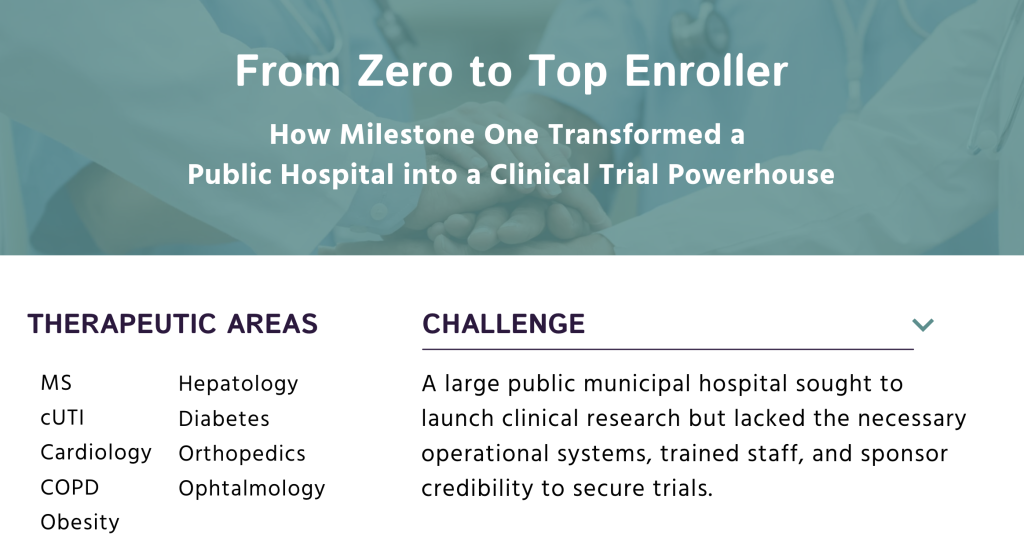
From Zero to Top Enroller: How Milestone One Transformed a Hospital into a Clinical Trial Powerhouse

From Zero to Top Enroller:
How Milestone One Transformed a Public Hospital into a Clinical Trial Powerhouse

How does a busy hospital with no prior research infrastructure transform into one of the country's top-performing clinical trial sites? This case study demonstrates how Milestone One provided targeted support to overcome steep barriers, including limited clinical trial knowledge, heavy physician workload, slow contracting, and a lack of established processes, ultimately turning these challenges into a success story.

By building and training a motivated research team, streamlining administration, and providing hands-on operational oversight, Milestone One helped the hospital secure 18 clinical trial opportunities across multiple therapeutic areas. The site has already surpassed enrollment expectations, more than doubling patient projections in a global cUTI trial, while achieving flawless audit results with zero protocol deviations.

Download the full case study to discover how Milestone One’s proven model accelerates site readiness, drives exceptional performance, and builds sponsor confidence from day one.
The Participation Gap: Expanding Access and Representation in Oncology Trials

The Participation Gap: Expanding Access and Representation in Oncology Trials

6

Despite being critical to the development of new cancer therapies, oncology clinical trials continue to face a major hurdle: low patient participation and enrollment. This challenge is compounded by disparities in trial access and representation, often driven by socio-economic barriers, limited availability of trial sites—particularly in underserved or rural areas—and a general lack of awareness and education about clinical research among patients. In a study evaluating the overall participation of patients in Commission of Cancer clinical trials (which represent more than 70% of all oncology-focused trials in the US), only 7.1% of patients with cancer participated in a clinical trial.1 Of all patients with GI-related malignancies, only .2% enrolled in clinical trials.2

So why do only a fraction of patients choose to enroll in a clinical trial within one of the most prevalent therapeutic areas for disease worldwide?

In oncology clinical trials, there is often a high burden on the patient due to the nature of disease manifestation, progression, and requirements for current treatment methods. There is also a lack of sites amongst community health centers and more rural geographies, which can create additional challenges for patients who cannot travel to larger hospital or university sites, where clinical trial involvement is more prevalent.

At Milestone One, our mission is to enable research-naïve sites to get involved in clinical research, increasing access to innovative and alternative therapies for patients who would otherwise not have such access. Our transformative approach to clinical research support helps alleviate the burden for sites through administrative and operational support. We help investigators and sites bring ground-breaking treatment options to their patients and gain the experience necessary to run clinical trials, regardless of size or location.

Discover how easy it is to become part of the future of clinical research

Research isn’t just reserved for large institutions anymore, and with Milestone One, you have the power to help bring innovative treatments to patients. If you’re ready to get involved in clinical trials but are unsure of how to start, we’d love to discuss your site’s needs today. 

1 Joseph M. Unger et al. National Estimates of the Participation of Patients With Cancer in Clinical Research Studies Based on Commission on Cancer Accreditation Data. JCO 42, 2139-2148(2024). DOI:. 10.1200/JCO.23.01030.


2 Muhammad Muntazir Mehdi Khan, Muhammad Musaab Munir, Selamawit Woldesenbet, Mujtaba Khalil, Yutaka Endo, Erryk Katayama, Abdullah Altaf, Mary Dillhoff, Samilia Obeng-Gyasi, Timothy M. Pawlik, Disparities in clinical trial enrollment among patients with gastrointestinal cancer relative to minority-serving and safety-netting hospitals, Journal of Gastrointestinal Surgery, Volume 28, Issue 6, 2024, Pages 896-902, https://doi.org/10.1016/j.gassur.2024.03.027.

Get in touch with Milestone One

Learn more about how Milestone One can help take the complexity out of clinical trials.

Contact us today

Overcoming Distance and Disparity: Engaging Rural, Research-Naïve Sites in Clinical Trials

Overcoming Distance and Disparity: Engaging Rural, Research-Naïve Sites in Clinical Trials

3

Meeting enrollment targets presents a challenge for almost every clinical trial. Yet, many sponsors miss the opportunity to reach eligible patients in “rural” and under-served geographic areas, which make up about 19% of the total population of the US,1 due to the potential challenges of engaging smaller, potentially research-naive sites.

There remains a gap in clinical trial education, access, and enrollment for patients outside urban centers, particularly in therapeutic areas with highly complex protocols and ultra-specific eligibility requirements like oncology and gastroenterology. In a recent study of 44 phase 2 and 3 oncology clinical trials, only “19.4% of patients (7184 of 36,995) were from rural locations.”2 From the sponsor’s point of view, community and local sites are often dismissed as enrollment options as they tend to have fewer patients overall. To the site, running a clinical trial may seem overwhelming and time-consuming where resources are already constrained. Finally, from the patient’s perspective, challenges in participating in trials can include travel feasibility, financial constraints, and a lack of education or general. 3 4

However, by implementing clinical trials at rural and research-naive sites, patients can gain access to potential treatment options that were previously out of reach.5

At Milestone One, we understand the value of closing the access gap for underserved and diverse populations to increase patient outcomes6 and access to clinical trials. Through our intimate understanding of small and rural sites’ pain points, including financial concerns, time limitations, technology, and staffing shortages,7 we work to eliminate these barriers.

Milestone One focuses on setting up infrastructure at each site through administrative and operational support at no direct cost – so that investigators can focus on what matters most: their patients. This also allows sites and providers to gain experience running trials with less financial risk or the burden of administrative work during start-up. We tailor clinical trial support to each site during the education and startup process, evaluating their skillset, capacity, and need.

Ready to Take the First Step?

Clinical research is no longer reserved for large institutions. With Milestone One, physicians can confidently enter the research space, provide patients with access to cutting-edge treatments, and foster growth within their facility.

Contact us today and discover how easy it is to become part of the future of clinical research.

1 Bharucha, Adil E, Chung Il Wi, Sushmitha Grama Srinivasan, Hyuckjae Choi, Phillip H Wheeler, Jennifer R Stavlund, Daniel A Keller, Kent R Bailey, and Young J Juhn. “Participation of Rural Patients in Clinical Trials at a Multisite Academic Medical Center.” Journal of clinical and translational science, July 12, 2021.
https://pmc.ncbi.nlm.nih.gov/articles/PMC8596068/#:~:text=Conclusions:,and%20urban%20participants%20in%20trials.


2 Unger JM, Moseley A, Symington B, Chavez-MacGregor M, Ramsey SD, Hershman DL. Geographic Distribution and Survival Outcomes for Rural Patients With Cancer Treated in Clinical Trials. JAMA Netw Open. 2018 Aug 3;1(4):e181235. doi: 10.1001/jamanetworkopen.2018.1235. PMID: 30646114; PMCID: PMC6324281.
https://pubmed.ncbi.nlm.nih.gov/30646114/


3 4 Murthy, V. H., Sateren, W. B., Ford, J. G., Haynes, M. A., Gosschalk, A., Eberhardt, M. S., Ricketts, T. C., Probst, J. C., Phillips, C. D., Medicine, I. of, Baldwin, L.-M., Lara, P. N., & Advani, A. S. (2011a, March 31). Rural–urban differences in discussions of cancer treatment clinical trials. Patient Education and Counseling.
https://www.sciencedirect.com/science/article/abs/pii/S0738399111001248


5 Bhatia, S., Landier, W., Paskett, E. D., Peters, K. B., Merrill, J. K., Phillips, J., & Osarogiagbon, R. U. (2022, July 11). Rural-urban disparities in cancer outcomes: Opportunities for Future Research. Journal of the National Cancer Institute.
https://pmc.ncbi.nlm.nih.gov/articles/PMC9275775/


6 Bhatia, S., Landier, W., Paskett, E. D., Peters, K. B., Merrill, J. K., Phillips, J., & Osarogiagbon, R. U. (2022, July 11). Rural-urban disparities in cancer outcomes: Opportunities for Future Research. Journal of the National Cancer Institute.
https://pmc.ncbi.nlm.nih.gov/articles/PMC9275775/


7 Diaz, N. (January 17, 2025). “We have to Rethink Rural Healthcare”: Inside Intermountain’s coalition. Becker’s Hospital Review.
https://www.beckershospitalreview.com/healthcare-information-technology/we-have-to-rethink-rural-healthcare-inside-intermountains-coalition.html

Get in touch with Milestone One

Learn more about how Milestone One can help take the complexity out of clinical trials.

Contact us today

Empowering Sites to Step into Clinical Research With Ease

Empowering Sites to Step into Clinical Research With Ease

7

For clinical sites with limited or no experience in clinical research, the idea of stepping into this complex field can feel overwhelming. From navigating regulations to finding qualified staff, the barriers to entry often seem insurmountable. Milestone One, a site enabling organization, offers a solution designed to bridge the gap and empower clinical sites to participate in research with confidence and ease.

Breaking Down Barriers

Milestone One alleviates the burdens that typically accompany entering the clinical research space. Unlike traditional Site Management Organizations (SMOs), Milestone One operates on a unique model where there are no direct out-of-pocket costs for our support. This means that facilities can explore the opportunity to offer clinical research as a service line without shouldering any financial risk.

By working with Milestone One, sites can bypass the steep learning curve and resource strain that often deter smaller sites from participating in clinical trials. Instead, they can focus on delivering high-quality patient care while expanding access to research opportunities.

The Benefits of Collaboration

Adding clinical research as a service line brings a wealth of advantages to healthcare facilities:

  1. Patient Retention
    Traditionally, patients seeking advanced treatments through clinical trials might need to be referred to larger institutions. By becoming a research-capable site with Milestone One, facilities can retain these patients, offering them innovative treatment options close to home.
  2. Community Impact
    Expanding access to clinical trials at smaller sites helps bring innovative therapies directly into communities, improving health outcomes for patients who might not otherwise have the opportunity to participate.
  3. Revenue Growth
    With no direct out-of-pocket costs to absorb, research programs introduced through Milestone One have the potential to generate additional revenue for facilities. This enables sites to diversify their income streams while contributing to cutting-edge medical advancements.

A Seamless Transition Into Research

Milestone One’s all-inclusive approach eliminates the need for facilities to manage logistics or absorb additional administrative burdens. With our administrative and operational support, details are handled with precision and expertise. This ensures that clinical sites can seamlessly integrate research into their offerings without disrupting their current operations.

Ready to Take the First Step?

Clinical research is no longer reserved for large institutions. With Milestone One, clinical sites can confidently enter the research space, provide patients with access to cutting-edge treatments, and foster growth within their facility.

Contact us today and discover how easy it is to become part of the future of clinical research.

Get in touch with Milestone One

Learn more about how Milestone One can help take the complexity out of clinical trials.

Contact us today

Clinical Site Coordinator Training: The Secret Ingredient of Effective Clinical Trials

Clinical Site Coordinator Training: The Secret Ingredient of Effective Clinical Trials

2

In a recent survey by Advarra, 60% of site respondents highlighted a need for improved communications as “important” or “very important.” Clinical trials are becoming more complicated, with many logistical pieces that need to be managed that physicians often don’t have the time to handle. Clinical Site Coordinators (CSCs) can help bridge that gap, allowing your site to focus on what matters: the patient.

With a CSC on site taking care of communication, staffing, and planning, physicians can focus on the patient and their needs. Notably, a Clinical Site Coordinator can help a patient navigate through the entire process of enrolling and participating in a study. As the complexities of CSCs are used to fulfill all sorts of functions to optimize site outcomes. As clinical trials grow, so does the need for more experienced CSCs to be able to manage this task effectively.

At Milestone One, our mission is to bring clinical trials to much wider populations of sites and patients around the world. We invest in comprehensive training to get CSCs trained and ready for sites, strongly emphasizing mentorship and continuing education to keep up with these changes. We want to invest in the future and the growth of clinical site coordinators so that sites like yours can play an important role in advancing this life-changing research for more patients.

With Milestone One, your site has the option of how you want to work with us: our team of trained professionals can easily ingratiate into research active sites to assist with ongoing projects, or work with facilities that have never participated in research to get a trial up and running from scratch.

Either way, the goal is the same: working with you and the sponsor to increase study enrollment and providing quality data.

Are you interested in learning more about how Milestone One can help your site manage complexity to take on more studies or get involved in clinical research for the first time?

Reach out to the Milestone One team today

Get in touch with Milestone One

Learn more about how Milestone One can help take the complexity out of clinical trials.

Contact us today

CRCs: How Prioritizing This One Role Makes Clinical Trials Work Better

CRCs: How Prioritizing This One Role Makes Clinical Trials Work Better

5

The role of the clinical research coordinator (CRC) is one of the most important in clinical studies, yet also one of the most poorly defined (the role even goes by several different names, including the study coordinator, trial manager, and research specialist).

Lance Roller II, a population/public health manager at Vanderbilt University Medical Center, explains in a article for Undark that “[r]esponsibilities vary but generally include study protocol development, recruitment of volunteers, budgeting, billing, data management, banking of biospecimens, and regulatory duties, among others” – all tasks that are fundamental to supporting sites in the success of a well-functioning clinical trial. The demands of this critical role frequently lead to burnout and turnover, which can further lead to catastrophic delays.

Roller was recently part of a research team that surveyed members of the American Association for Bronchology and Interventional Pulmonology to learn more about perceptions of the role among coordinators and investigators. The findings were stark, especially around the training the role receives:

There was a clear gap around training. Investigators reported directly training their coordinators less than half the time, and 20 percent did not know how their coordinators were trained. Coordinators reported being trained by their senior colleagues and doing online or self-directed training at higher rates than investigators perceived.

This gap highlights how the role has historically been undervalued, but the team also found the lack of recognition visible in other ways. “I felt like I did a lot of the work, but I wasn’t recognized for it when it came down to writing the articles. I wasn’t able to be a part of that,” said one coordinator. “However, I did 89 to 99 percent of the data collection.”

Learn more about the findings in the full article.

Milestone One enables CRCs with customized training programs and tailored support to help your site succeed. If your site has experienced challenges in the past or is looking to get involved in clinical research for the first time, it’s time to experience a better way. Contact us today to get started.

Get in touch with Milestone One

Learn more about how Milestone One can help take the complexity out of clinical trials.

Contact us today

Why Sponsors May Be ‘Asking the Wrong Questions’ When Choosing Trial Sites

Why Sponsors May Be ‘Asking the Wrong Questions’ When Choosing Trial Sites

4

New breakthroughs in AI and personalized vaccines are redefining oncology research. Has our definition of what a successful trial site looks like kept up? In an article for Fierce Healthcare, Marcy Kravet argues that sponsors often still look for the wrong things in site selection, increasing site underperformance and lack of diversity in trials.

Instead, “[s]ponsors need to retire the current definition of what makes a site a ‘good site’ and bring forth a willingness to look to lesser-known, but experienced and motivated, sites for their trials.”

I spent over 15 years at large pharmaceutical companies witnessing the site selection process become more and more data driven. During that time, I led feasibility teams, owned the company SOP on country and site selection, and worked with clinical operations personnel to ensure local intelligence on standard of care and practice patterns were considered in site selection decisions. Across these roles, the common goal was finding the right sites to bring in the right patients who needed access to care, yet our system for identifying motivated, qualified researchers reduced sites to data points.

When selecting sites based on historical data and feasibility responses, large sites with extensive industry experience have the advantage. However, many of these top-tier sites still struggle to perform as more trials are launched, even as they remain the first choice for sponsors working in the same indication.

“Progress requires sponsors to funnel their innovation into rewriting the definition of a good site,” says Kravet. “It calls for a shift away from antiquated data sets and towards a novel approach that promotes tier-three sites from the bottom of the list, recognizing the power of communities.”

Read the full article here

If you’ve been curious about getting your site involved in clinical research, we can help. Milestone One provides services to alleviate administrative burdens and fill gaps to increase enrollment and study quality, leading to a streamlined and fulfilling experience for your site. Click here to learn more and find out how you can get involved.

Get in touch with Milestone One

Learn more about how Milestone One can help take the complexity out of clinical trials.

Contact us today

Milestone One Transforms Clinical Research Support Worldwide

Milestone One Transforms Clinical Research Support Worldwide

11

Zug, Switzerland – July 26, 2024—Milestone One is proud to introduce a transformative approach to clinical research support. By streamlining the complexities of clinical trials and providing unparalleled operational and administrative support to research sites around the world, Milestone One is poised to transform the clinical trials landscape and help sites bring innovative therapies to patients faster.

Clinical trials are essential for advancing medical breakthroughs, yet the administrative burden often deters potential research sites from participating. Milestone One recognizes this challenge and aims to alleviate the overwhelming demands placed on medical institutions by offering comprehensive support services, empowering research sites to focus on what truly matters — delivering innovative therapies to patients.

“At Milestone One, we understand that running clinical trials can feel insurmountable for the average healthcare institution,” says Agnieszka Rogowska, Managing Director. “Our mission is to break through the red tape, simplify processes, and foster lasting partnerships with research sites. We believe in facilitating sustainable outcomes and inspired solutions that drive medical progress.”

Milestone One’s approach is centered around efficiency, expertise, and innovation. By leveraging dedicated support teams, a service-first model and a team of seasoned professionals with more than 30-years of global industry experience, Milestone One collaborates with research sites to navigate the complexities of clinical trials seamlessly. Milestone One provides end-to-end support tailored to each site’s unique needs.

Collaborating with Milestone One offers many benefits, including faster patient recruitment, better study data quality, and enhanced protocol compliance. Additionally, partners receive on-site assistance for study patients and medical teams, ensuring smooth operations and optimal patient care throughout the duration of a trial.

For more information about Milestone One, visit www.milestoneone.com.

About Milestone One

Milestone One provides operational and administrative support for clinical research sites worldwide and offers services tailored to each site’s unique needs. By fostering lasting collaborations and delivering inspired solutions, Milestone One empowers research sites to bring innovative therapies to patients.

Get in touch with Milestone One

Learn more about how Milestone One can help take the complexity out of clinical trials.

Contact us today